Asset Classes in Trading: What Each One Is Actually For
Asset classes in trading explained: forex, commodities, indices, stocks and ETFs, what moves each, and trading all five on one MT5 account. Covers stock CFDs and gold.
By Nexora Capital Markets — Editorial team
Published: Oct 31, 2026
Updated: Nov 3, 2026

Table of Contents
- 1.What is an asset class?
- 2.The five asset classes at a glance
- 3.Forex: one economy against another
- 4.Commodities: supply, demand and the dollar
- 5.Indices: one view on a whole market
- 6.Stocks: a view on a single company
- 7.ETFs: a basket in one instrument
- 8.Why holding all five on one account changes how you plan
- 9.How to choose where to start
- 10.Common mistakes when trading several asset classes
- 11.Putting it together
Most traders start with one market, often a major currency pair or gold, and only later discover how much else sits on the same platform. The challenge is not a lack of choice. It is knowing what each market is actually for.
This guide covers the main asset classes in trading available on a Nexora account: forex, commodities, indices, stocks and ETFs. For each one, we look at what you are trading, what tends to move it, and what traders typically use it for, then at why holding all five on one MetaTrader 5 account changes how you plan.
Key takeaways
• An asset class is a group of markets that tend to respond to the same kinds of drivers.
• Forex moves on interest rates and economic data; commodities on supply, demand and the US dollar.
• Indices give one view on a whole market, stocks a view on one company, and ETFs sit in between.
• More markets do not automatically mean more diversification; several positions can be the same bet.
• Check each instrument's trading hours, contract size, and margin in MT5 before you trade it.
1. What is an asset class?
An asset class is a group of financial instruments that behave in similar ways and respond to similar drivers. Knowing which class a market belongs to tells you where to look for the news that moves it, when it is open, and how it may react to the same event as your other positions.
On a Nexora account, you can trade more than 500 instruments across five asset classes as CFDs (contracts for difference). With a CFD, you trade the price movement without owning the underlying asset, and you can take a position on prices rising or falling.
2. The five asset classes at a glance
Asset class | What you trade | What tends to move it | Often used for |
|---|---|---|---|
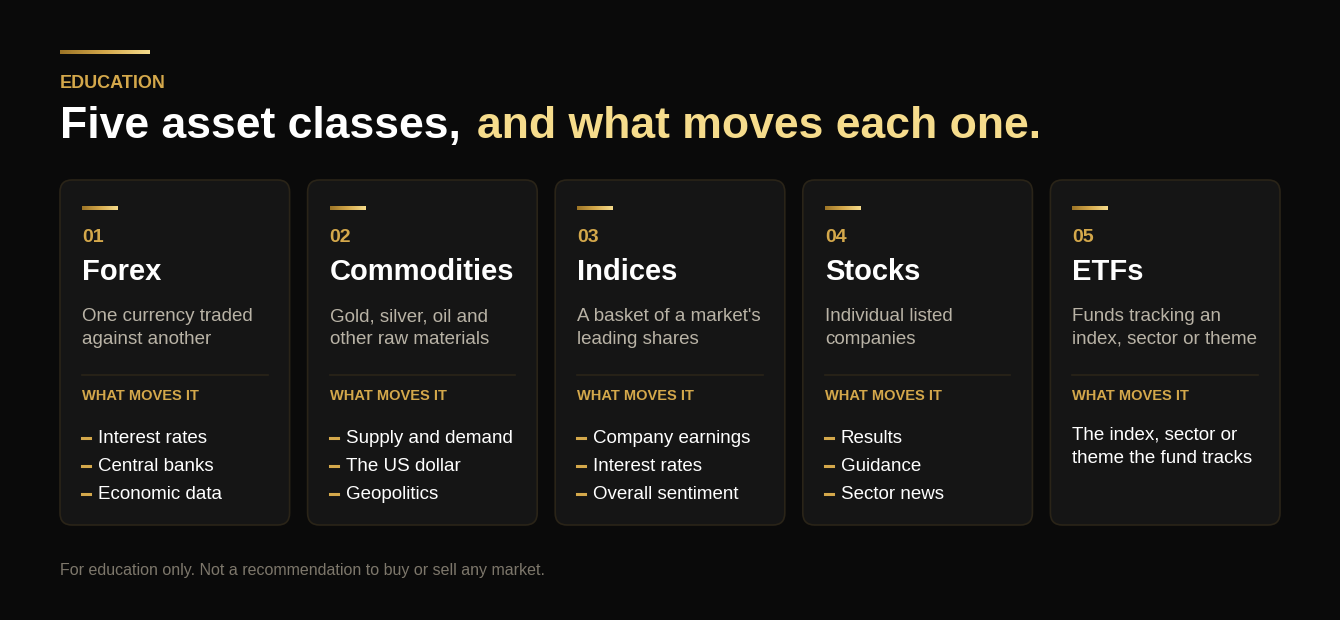
Forex | One currency against another, such as EUR/USD | Interest rates, central banks, economic data | Views on economies and monetary policy |
Commodities | Gold, silver, oil and other raw materials | Supply and demand, the US dollar, geopolitics | Views on inflation, growth and sentiment |
Indices | A basket of leading shares from one market | Company earnings, interest rates, overall sentiment | One view on a whole stock market |
Stocks | Individual listed companies | Results, guidance, sector news | Views on specific businesses |
ETFs | Funds tracking an index, sector, or theme | Whatever the fund tracks | Broad or themed exposure in one instrument |
3. Forex: one economy against another
Forex is the largest and most actively traded financial market in the world. Every forex trade is a pair: buying EUR/USD means buying the euro and selling the US dollar at the same time, so you are really comparing two economies.
Currency pairs respond most to interest rate expectations, central bank decisions, and economic releases such as inflation and employment data. The market trades around the clock from Monday to Friday, with activity moving between the Asian, European and US sessions. Major pairs usually have tighter spreads than minor and exotic pairs.
4. Commodities: supply, demand and the dollar
Commodities are physical goods: precious metals such as gold and silver, and energy such as crude oil. Their prices reflect real-world supply and demand, and also the US dollar, since most commodities are priced in dollars.
Gold is many traders' first commodity. It often draws attention during periods of uncertainty and tends to respond to interest rates and the dollar. Oil reacts to production decisions, inventory data, and expectations for global growth. Both can move sharply on geopolitical news.
5. Indices: one view on a whole market
A stock index measures the performance of a group of companies, such as the largest companies listed in one country. Index trading lets you take one position on the direction of a whole market rather than choosing individual companies.
Indices respond to corporate earnings, interest rates, and overall risk sentiment. Because one company's bad news is diluted across the basket, an index is usually less exposed to a single surprise than an individual stock, although it can still move sharply on broad market events.
6. Stocks: a view on a single company
Stock CFDs let you trade the share price of individual listed companies. Here the drivers are specific: quarterly results, guidance, management changes, and news about the sector.
Stocks trade during their exchange's hours, and prices can gap at the open after earnings or overnight news. Stock CFD positions may also be adjusted for dividends and other corporate actions, so check the details for each instrument before trading.
7. ETFs: a basket in one instrument
An exchange-traded fund (ETF) is a fund that tracks something: an index, a sector, a commodity, or a theme. Trading an ETF CFD gives you exposure to that whole basket through one instrument.
ETFs sit between indices and stocks. They can be broader than a single company and more targeted than a headline index, for example, tracking one sector rather than the whole market. Like stocks, they follow their exchange's trading hours.
8. Why holding all five on one account changes how you plan
Trading five asset classes from one MetaTrader 5 account, with one login, one balance, and one statement, makes it easier to see your whole exposure at once. It also brings three planning points that single-market traders can often ignore.
Your positions share one margin pool
Every open position draws on the same balance and free margin. A losing trade in one market reduces the margin available to all the others, so risk has to be planned across the account, not trade by trade.
Different markets can be the same bet
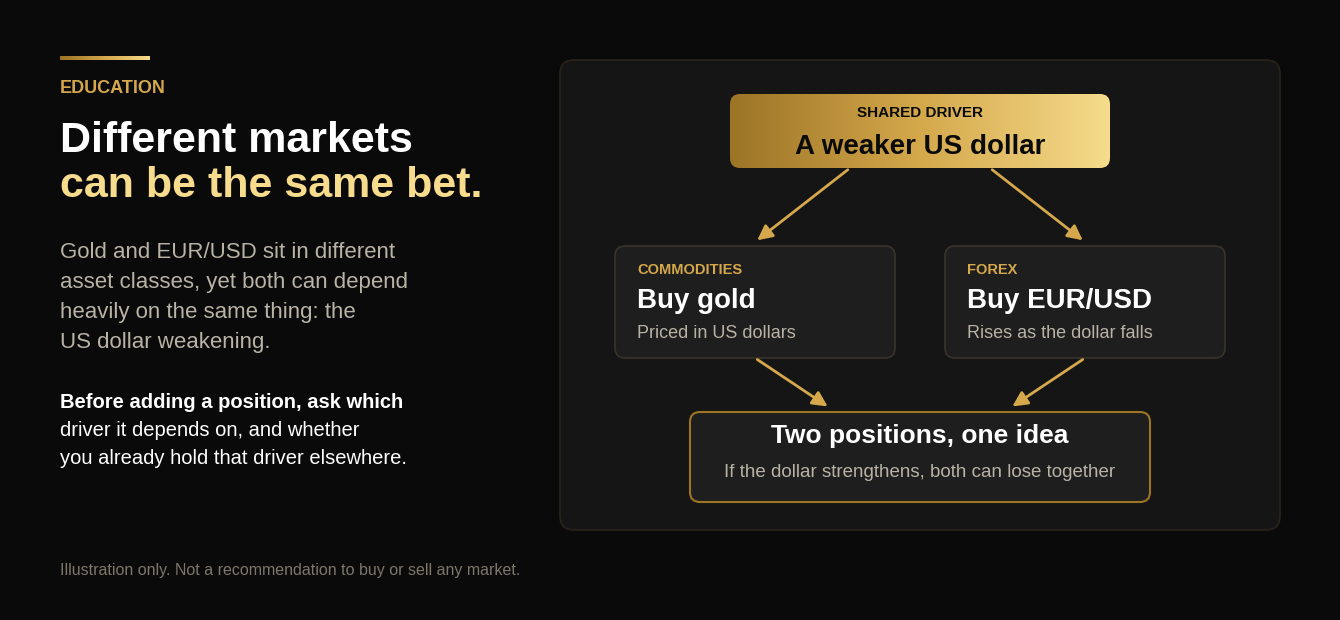
Positions in different asset classes can depend on the same driver. Buying gold and buying EUR/USD, for example, can both rely heavily on the US dollar weakening. Five positions in five markets can still be one idea, with five times the exposure.
Each market keeps its own clock and specification
Trading hours, contract sizes, spreads, margin requirements and overnight swap charges differ between instruments. On MT5 desktop, right-click any symbol in Market Watch and choose Specification to see its details before you trade.
9. How to choose where to start
There is no best asset class, only the one that suits what you follow and the time you have. Three questions help:
1. What do you already follow? If you read economic news, forex may make sense first. If you follow particular companies, stocks may feel more natural.
2. When can you trade? Choose markets that are active when you are available, not ones that move while you are asleep.
3. How much can you watch? Start with one or two markets and learn how they behave before adding more.
Whichever you choose, practice on a free demo account first. If you have not chosen a broker yet, our guide on how to check a forex broker before you deposit explains what to look at.
10. Common mistakes when trading several asset classes
• Assuming more markets means more diversification. Check whether your positions share a driver.
• Using the same position size everywhere. One lot means different things on different instruments, so size each trade from its specification.
• Ignoring trading hours. A stock or ETF position cannot be closed while its market is shut, and it can gap at the open.
• Overlooking overnight costs. Holding a position overnight can add a swap charge or credit, and the rate is different for each instrument.
• Chasing whichever market is moving. Jumping between markets without a plan usually means trading the one you understand least.
11. Putting it together
Each asset class answers a different question about the world: how an economy is doing, what a resource is worth, where a market is heading, how a company is performing, or how a sector is faring. Understanding the asset classes in trading starts with knowing which question you are asking.
Once you know which market you want to trade, our guide to the types of orders in trading will help you decide how to enter and exit, including how orders behave when a market reopens after a gap. To trade them live, open a live account through the Nexora client area.
Frequently asked questions
What are the main asset classes in trading?
For retail traders on MT5, the main asset classes are typically forex, commodities, indices, stocks, and ETFs, usually traded as CFDs.
Which asset class is best for beginners?
No single asset class is best for everyone. Many beginners start with a major forex pair or gold because they are widely followed and well covered by the news, but the right choice depends on what you understand and when you can trade.
Can I trade forex and stocks on the same account?
Yes. On a Nexora account, forex, commodities, indices, stocks, and ETFs are all available on one MetaTrader 5 account, with one balance and one login.
What is the difference between an index and an ETF?
An index is a measure of the performance of a group of shares, while an ETF is a fund that tracks an index, sector, commodity or theme. Both give exposure to a basket through a single instrument.
What moves the price of gold?
Gold tends to respond to interest rates, the US dollar, inflation expectations and periods of uncertainty, as well as physical supply and demand.
Do all markets trade at the same hours?
No. Forex trades around the clock from Monday to Friday, while stocks and ETFs follow their exchange's session. You can check each instrument's hours in MT5 under Specification.
Do I own the shares when I trade stock CFDs?
No. A CFD lets you trade the price movement of a share without owning it, so you do not receive shareholder rights such as voting.
Disclaimer: Risk warning: Trading leveraged products such as forex and CFDs carries a high level of risk and may not be suitable for every investor. You may lose some or all of your invested capital. This article is for educational purposes only and is not investment advice. Nexora Capital Markets Ltd (Company Number: 237992 GBC) is licensed by the Financial Services Commission, Mauritius (licence no. GB26206605). Revenue share depends on tier qualification and is not a forecast or indication of actual earnings.